Selected work
OmniSpa
An in-production operations platform connecting booking, service delivery, checkout and shift reconciliation across multi-branch beauty businesses.
OmniSpa does not treat a booking as the end of the work
From the outside, a booking is the most visible part of a spa or beauty business. For the person operating a branch, it is only the beginning. Someone prepares the staff assignment, delivers the service, records products, receives payment and checks the transactions before the shift can close.
When those responsibilities are handled in separate tools or informal handoffs, the schedule may not reach the person serving the customer, checkout may lose the service context and end-of-shift reconciliation becomes a manual reconstruction of what happened.
The ZiniSoft team built OmniSpa to keep those steps in one chain of responsibility. The product has supported live operations since 2024 across multi-branch and multi-brand contexts.
The difficult part sits between booking and shift closure
Customers need a simple way to find a service and book. Branch staff need to see the queue, who will serve the customer and whether the visit is pending, checked in or checked out. Owners and managers need revenue, transactions, exceptions and work that is still waiting.
Those roles do not need the same screen, but they must share the same context. When the information breaks between them, staff ask customers to repeat details, transactions lose their service context and the person closing the shift has to reconstruct events from memory or messages.
At the financial boundary, software can calculate and prepare the record. The operator still confirms the actual money, explains differences and takes responsibility for closing the shift.
From separate records to one operating loop
Before
Customer booking, branch scheduling, service delivery, checkout and management reporting could become separate records. The difficult part was not storing each record. It was preserving responsibility as the work moved from the customer to the branch, then from the branch to financial review and management oversight.
Intervention
OmniSpa connects three operating surfaces. Customers use a mobile experience to discover services, book and review their activity. Branch teams use POS workflows to manage appointments, sell services and products, take payment and operate through temporary connectivity interruptions. Owners and managers use the administration workspace to control catalog, branches, staff access, customer programs, orders, transactions and reports.
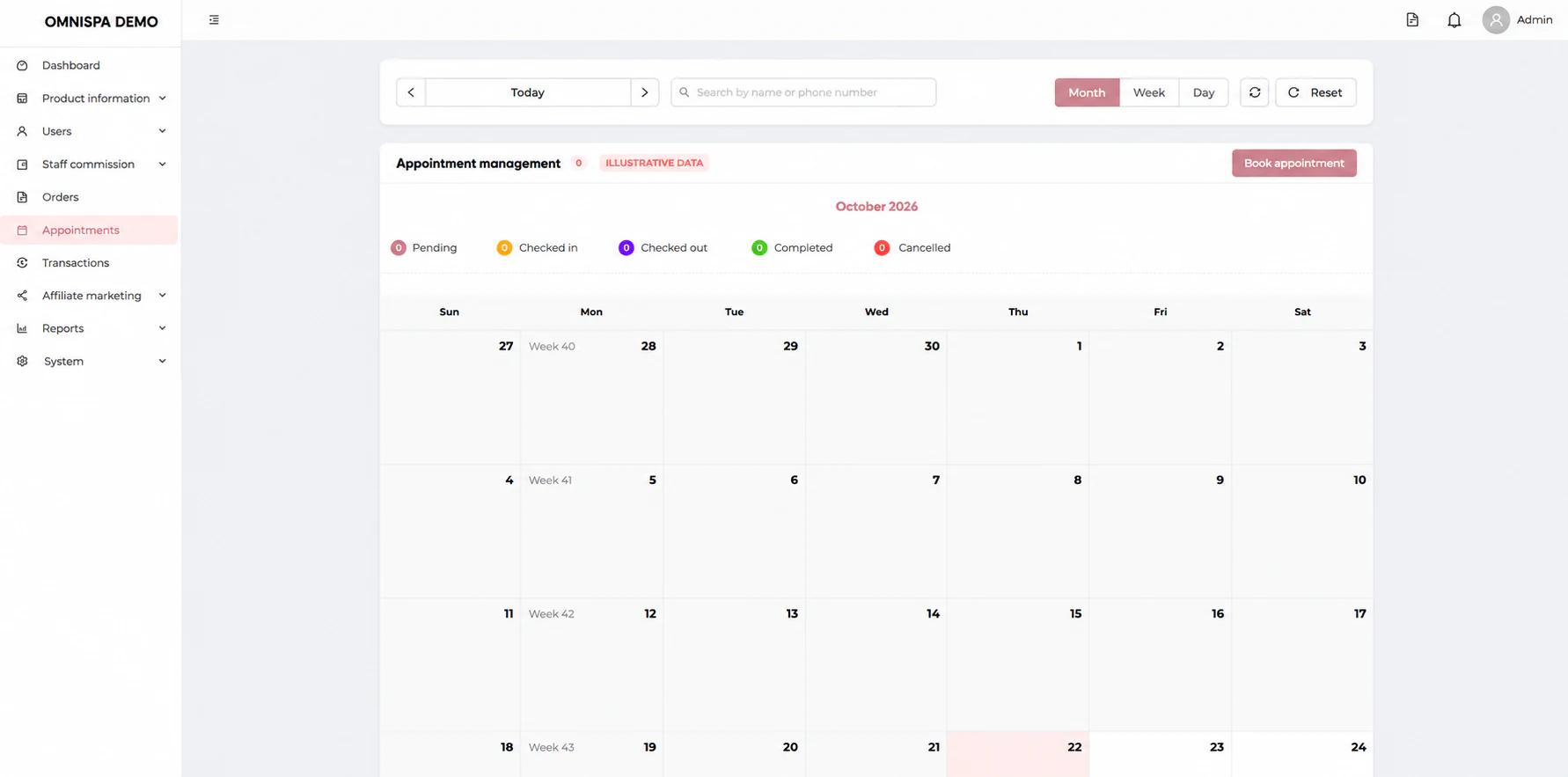
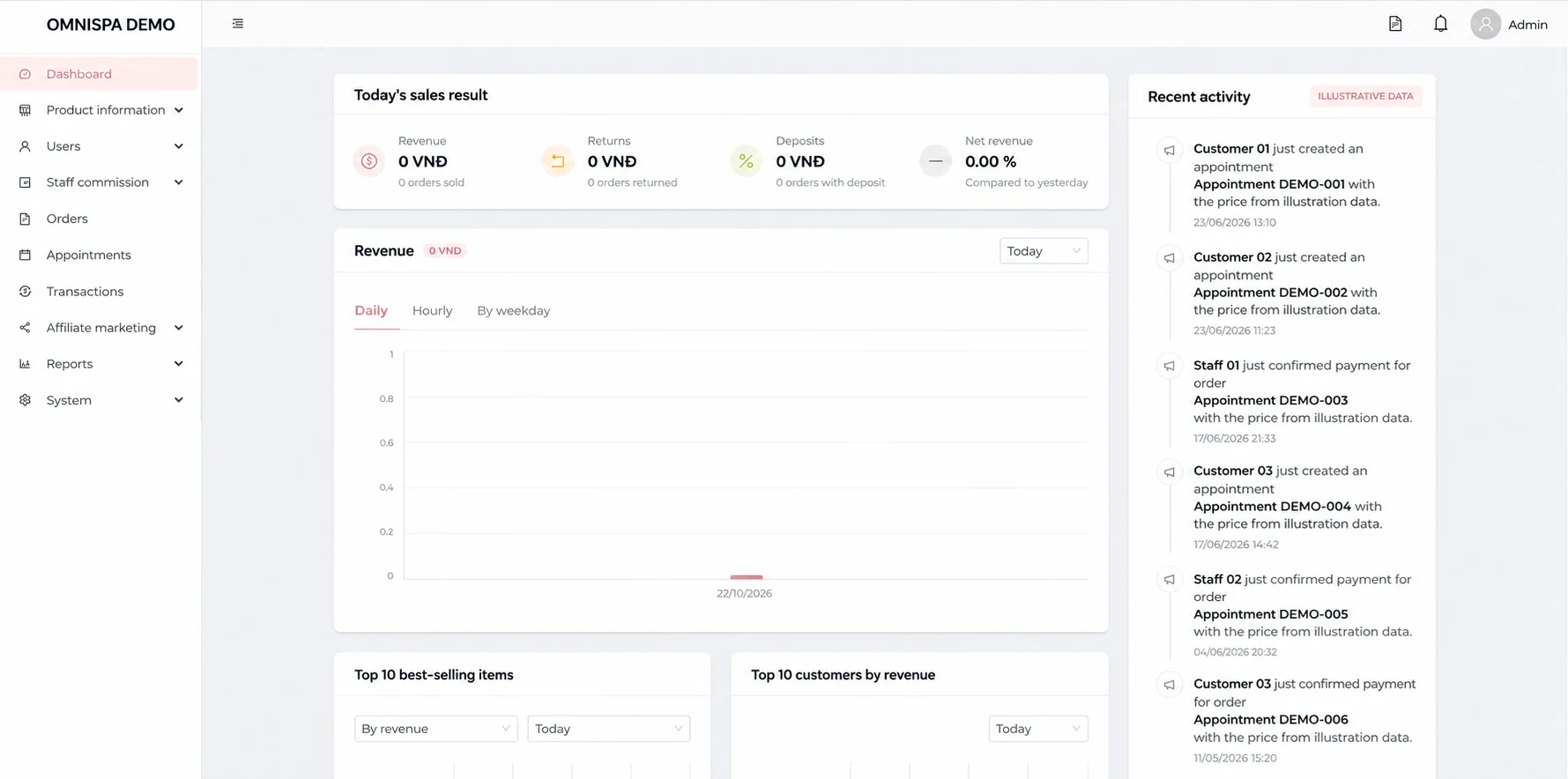
The appointment workspace makes the service lifecycle explicit through pending, check-in, check-out, completion and cancellation states. The management dashboard brings daily business results and recent operational activity into one review surface.
The system does not remove human control from money or service exceptions. Staff confirm customer-facing changes, review payments and close a shift only after checking its transaction summary.
Current state
OmniSpa supports live paid deployments and has been in operational use since 2024. The product is also going through platform modernization so the existing production operation can continue while shared contracts, multi-brand standards and delivery controls are made easier to maintain.
Public evidence
- Live paid deployments have operated since 2024 without disclosing customer identity or deployment count.
- One operating model supports multiple branches and configurable brands.
- Customer, branch and management workflows are connected through mobile, POS and administration surfaces.
- Appointment status is visible from pending through check-in, check-out, completion or cancellation.
- The management workspace combines daily business results with a recent activity stream so an operator can review both aggregate outcomes and the events behind them.
- POS can retain orders during a connectivity interruption. Replaying those orders is an explicit operator action so recovery remains visible and accountable.
- Booking, checkout and end-of-shift review are represented as connected operating responsibilities rather than isolated features.
Processing time, number of manual steps and completion rate have not been measured to the publication standard for this case. No before-and-after performance claim is made.
Public operating model
- Booking intent: a customer selects a service and an available time through a supported channel.
- Branch schedule: the branch receives the appointment in a schedule that staff can review and act on.
- Service and checkout: the visit becomes a service or product order with a recorded payment path.
- Human shift review: the operator reviews cash movement, exceptions and the expected balance before closing the shift.
- Management visibility: owners and managers see the operating result across the relevant branch and brand context.
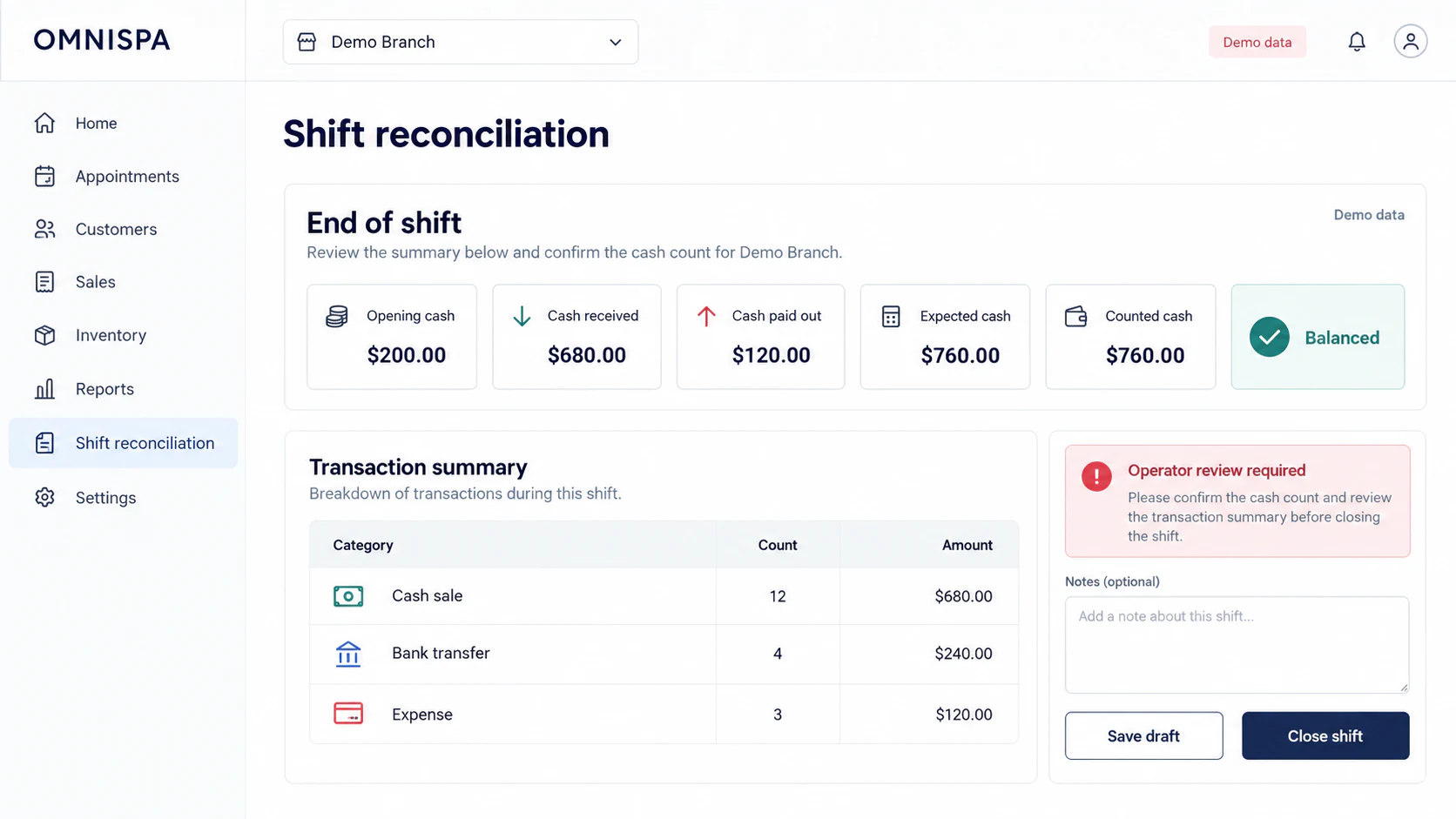
This is a reconstructed public model, not the internal architecture.
My role and the team’s responsibility
I am responsible for product direction, solution architecture and production operations. My work is to connect booking, branch execution, payment, recovery during connection loss and management control into a system that can continue to operate.
The ZiniSoft team builds and evolves the product. Business operators remain responsible for schedule changes, service exceptions, payment confirmation and shift closure. Product and engineering decisions are shared team work; this case does not imply sole authorship.
Decisions and trade-offs
One operating model, three role-specific surfaces
A single interface for every role would reduce code on paper but make daily work harder to control. OmniSpa separates the customer, branch and management experiences while keeping the operational records connected. The trade-off is a larger product surface and a stronger need for shared contracts.
Offline continuity with explicit recovery
Branch checkout cannot simply stop whenever connectivity becomes unstable. POS can retain orders locally, but replay is deliberately visible and manually initiated. This accepts an extra operator step in exchange for a clearer recovery boundary and lower risk of an unnoticed duplicate submission.
Configurable brands instead of duplicated products
Multiple brand presentations are handled through configuration and shared product foundations rather than separate codebases. This reduces divergence, but every shared change must still be checked across the supported brand contexts.
Human control at the financial boundary
The system can calculate expected cash and present transaction categories. A person still confirms the counted amount, reviews exceptions and closes the shift. Automation prepares the decision; it does not own the financial sign-off.
What OmniSpa taught me
A system for a service business cannot stop at a polished booking screen or a recorded payment. It needs to follow the work until the operator can explain what happened, which exceptions remain open and who confirmed the final number for the day.
OmniSpa also taught me that modernizing a production product is different from starting again. Every technical change must respect the data, habits and live operation already in place. A newer system has value only if the current work does not lose control during the transition.
Publication boundary
This case demonstrates how booking, branch execution, checkout and shift review can be connected in a production service operation. It does not disclose customer names, customer records, production schedules, transaction data, infrastructure, private endpoints or internal architecture.
The product screenshots have been sanitized and use neutral branding or fictional data. The shift review illustration is reconstructed. The case does not claim a measured reduction in processing time, manual effort or completion rate. Open implementation risks and internal migration details remain outside the public case unless they become a reviewed public lesson.